Pages

Wednesday, December 1, 2010

What every woman knows....


"Every man who is high up loves to think that he has done it all himself; and the wife smiles, and lets it go at that. It's our only joke."


So speaks the knowing wife, in J.M.Barrie's play of that name. Written in England in 1908, it preceded the Women's vote. It tells of a time when women were powerful in the home, but not in society at large. It took the efforts of thousands and thousands of women like Emily Pankhurst here, and on both sides of the Atlantic, to get the vote. They knew that no-one was going to hand power over to them. The sad lesson of human progress is that nobody gives away power for free, it has to be taken.


I mention this because of a discussion that has been going on in the Comments section, about how Saudi women can achieve real power, to be able to drive, to wear what they like, have equal rights in marriage, the list goes on.

I think the discussion was prompted by this young Saudi woman, (name hidden for obvious reasons) who had been denied her internet rights by her caring male relatives. It's nice to be able to report that she's back online although her language is still as ripe, but who can blame her....It seems that the dickless dicks have had a change of heart and I've been granted internet access. Nonetheless, they are still dickless dicks as far as I'm concerned, because this filthy country makes damn sure that the ball is always in their f*cking court.....and not only that, it looks as though one of her own gender is causing her problems....

UV: Who are you talking to, day and night?


Me: huh?

UV: Your mobile!

Me: What about it?

UV: Why is it ringing ALL THE TIME? WHO ARE YOU TALKING TO?

Me: Who do you think I’m talking to?!

UV: I don’t know. You tell me!

Me: It’s none of your God damn business!

And with that I walked off; ignoring her excruciating screaming.So now my phone’s being threatened. This is the bullcrap that I have to bloody endure. I’m 23 for f*ck sake. It does not concern ANYONE who the hell I’m talking to on the phone.

If every Saudi woman were like her, the streets would be buzzing with women driving to each others' houses, shops, schools and of course the places where they work, wearing bright clothing and sporting bare faces with makeup. But it is not so. And answering the question "How do we change things?" is not easy. The parallels with the suffragettes are very few:

1. They lived in democracies, the issue was their getting the vote for themselves; in Saudi Arabia, no-one gets the vote.

2. They lived in countries where political protest was acceptable and generally legal; in Saudi Arabia, a simple peaceful demonstration can buy you gaol time.

3. They were free to travel round and associate, which meant they could hold plan, organize, hold meetings, get together in large numbers; in Saudi Arabia, with the exception of trips to the shops or elsewhere where they are "allowed", they are generally confined to the house.

Let me illustrate the last point, and provide a sort of an etiquette guide at the same time. It's a bit of a Western misconception that in the home, women rule the roost. Now it is true that they can be very influential within the close family, but in no sense are they the "woman of the house". If as a male you are ever invited to a traditional Saudi house for a meal, with or without your wife ("significant others" don't get visas, sorry), this is more or less what will happen.

Husband will open the door and welcome you. There may well be an incense burner in the doorway, as a mark of greeting. Waft the smoke over your hair and clothes. Remove your shoes (best to come in sandals).
Husband will lead your wife to a back room. That is all you are going to see of her, all evening. Coffee or tea, and dates, will be ready on a table. You sit down (better on the floor), drink, eat, talk "guy talk". You may hear sounds of movement and rustlings from the next room. At a certain point, husband will lead you through to the next room where, miraculously, food will be laid out. The dishes are probably set out on a plastic sheet on the carpet. Nothing, and I am being absolutely serious here, beats eating in a reclining position, perhaps leaning on a decorative camel saddle, with the food at floor level, and using your hand (right, not left, but don't ask why) to eat. There will be enough to feed a small army. Arab hospitality demands that guests should never leave hungry. When you see all those dishes for just the two of you, including one with several small roast chickens, do not make the foolish assumption that this is the main course. PACE YOURSELF.

When you have assured your host that you have eaten all that you can manage from what is before you, he will remove many dishes. However he will return and replace them with an even larger selection of larger dishes. Carry on eating. Aren't you glad you are lying down? (It allows the stomach to distend more easily).
When you have eventually finished (NB If you are the "BellyBuster" champion at your local restaurant's "All you can eat Prime Rib Night", don't try and eat everything, they will only bring out more, so that you won't leave hungry) , you get up as best you can, and repair to the room you originally started out in, where miraculously fresh coffee will have appeared. Resume the horizontal once more. More "guy talk". There will be more sounds of rustling from next door.

As the evening draws to a close, husband will leave you and return from the back room with your wife. Say your farewells, put your shoes on, waft the incense, and out you go. Your wife will then inform you that your host also has a wife, who did all the cooking, and laid out and removed plates for the menfolk, not to mention coffee, as well as doing the same for herself and your wife. And you thought it was just a miracle.

[There is a slight variation to this routine, if the guests are male relatives of the husband. In that case the wife may emerge to pour coffee, but she will have a cloth draped over her head (rather like the cloth you would cover your parrot cage with, to shut it up) . Not that she's going to say anything, of course, she will just pour the coffee; the cloth is thin enough to allow her to see the spout and the cups, without curious male relatives being able to see her face].

The main point of that etiquette guide was just to show how little the typical Saudi wife is able to get out and about in her own house when the men are around, never mind get out and about in society at large. If you're going to be confined to a backroom or under a parrot-cloth, how the hell are you going to go out and organize a social revolution?

I wish to God I knew the answer, apart from collectively battering the men of Saudi Arabia over the head with a blunt instrument. First, the womenfolk need to get their attention. As every woman knows, there are two ways to get a man's attention:

1. Switch off the TV when his favorite sport is on.

2. Deny him his conjugal "rights".

The advantage of the second one is that it does not involve going out into the street waving banners. It can be done from the comfort of one's own home. Also, it does not break any criminal law. Carried out resolutely, it can be unbelievably effective. Ask the women of ancient Sparta, Boeotia, and Corinth, other societies where women did not have a voice. In Aristophenes' play "Lysistrata", the women, encouraged by the heroine of that name, went on strike in order to end the Peloponnesian War.


Here's some of the dialogue. It is a bit fruity, the ancient Greeks didn't go in for nuance or euphemism!

LYSISTRATA: We will all swear at once. Put your hands on the cup, everyone, and repeat after me. I shall not go near my husband or my lover.

ALL: I will not go near my husband or my lover.

LYSISTRATA: Speak up—No matter how big a hard-on he has.

ALL: No matter how big a hard-on he has.

LYSISTRATA: I will be completely celibate.

ALL: I will be completely celibate.

LYSISTRATA: And wear nothing but seductive clothing

ALL: And wear nothing but seductive clothing

LYSISTRATA: And get my husband as horny as possible

ALL: And get my husband as horny as possible

LYSISTRATA: But I will never willingly give in to him

ALL: But I will never willingly give in to him

LYSISTRATA: No matter how he pressures me

ALL: No matter how he pressures me

LYSISTRATA: And if he tries to force me


ALL: And if he tries to force me.

LYSTRATA: I will not do the thing where I put my legs up over his head

ALL: I will not do the thing where I put my legs up over his head

LYSISTRATA: Nor will I pretend to be a lioness he has caught in the forest

ALL: Nor will I pretend to be a lioness he has caught in the forest

LYSISTRATA: If I keep my oath, let my cup be filled with nothing but wine

ALL: If I keep my oath, let my cup be filled with nothing but wine

LYSISTRATA: And if I break it, let it be filled with nothing but water.

ALL: And if I break it, let it be filled with nothing but water.

LYSISTRATA: Do you all solemnly swear this oath?

ALL: We do.

There's my suggestion, for what it's worth. Will it be the start of the Great Saudi Sexual Strike of 2011 (1427)?

Tuesday, November 30, 2010

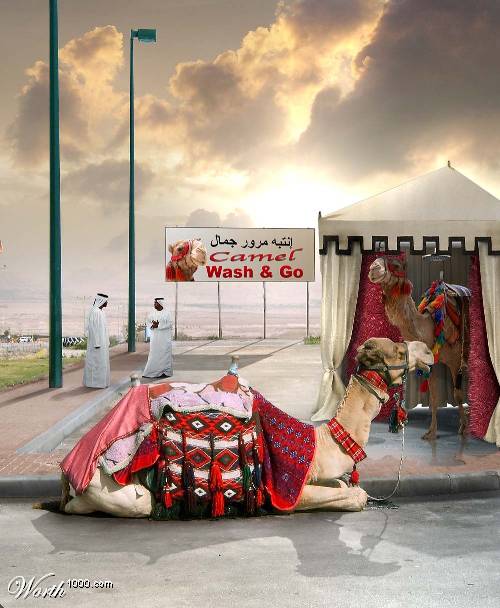
And yet again, camels

I may be able to resist Mme. Nicotine these days, but I can never resist a camel photo. And as for a whole silly, surrealistic one....

Thanks, "b_e"!


.


.


.


.


.


.

Khalas


In Memory of the lives of 15 Makkah Schoolgirls, lost when their school burnt down on Monday, 11th March, 2002. The Religious Police would not allow them to leave the building, nor allow the Firemen to enter.

Khalas: (Arabic): enough, no more, finished, that's it, the end.


It is with very mixed feelings that I post this. What about Saudi Arabia?  OK, the now-the-terrorists-are-surrounded-oops-they-got-away saga is over. Also, muslims worldwide will still be getting offended about something, not necessarily cartoons. But overall, I'm afraid, Saudi Arabia won't have changed. So I would just end up trying to say the same-old same-old, but in different ways. Meanwhile, none of us are getting any younger. Carpe Diem. Seize the day.

The blog will remain here for as long as Blogger does. Maybe, millenia from now, extraterrestrial digital archeologists will chance upon it, and wonder about this "Kingdom of Saudi Arabia" where half the people wore black and half the people wore white. An earnest Zargian Ph.D. student will expound in his thesis the theory that the land was so inhospitable, only chess pieces could live there. The rules of the game involved moving around a black rock in ever-decreasing circles. He will speculate as to whether, had the rock been in the Southern hemisphere, they would have circulated in the opposite direction.

They will be visible until Haloscan decides to archive them.

The Camel, God's most ingenious creation.

Woman, God's most sublime creation.

Ma'a Salaama.

Hate Denmark For Its Freedom, Not America

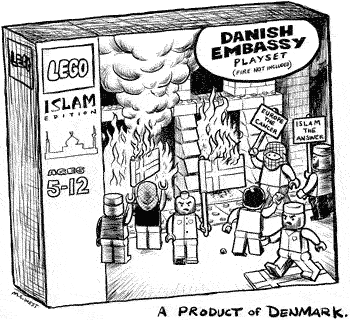
In September of 2005, the Danish newspaper Jyllands-Posten printed the now-infamous "Muhammad cartoons," sparking riots across the Muslim world, the burning of Danish embassies, and scores of deaths.


The cartoons were part of a nationwide debate on fundamentalist Islam, following the murder and attempted beheading of Danish filmmaker Theo Van Gogh (great-grandson of Vincent's brother) by a man who claimed his movie offended the sensibilities of Islam.


A week later, the left-leaning newspaper Politiken reprinted one of the cartoons, and Denmark found itself with another week-long riot in response.

The decision to reprint was a journalistic act of protest after an alleged plot to murder the cartoonist was foiled by police earlier that day. Politiken stated in an editorial: "Regardless of whether Jyllands-Posten at the time used freedom of speech unwisely and with damaging consequences, the paper deserves unconditional solidarity when it is threatened with terror."

This gesture by the journalists, balls swinging in the face of those who threaten to bomb and behead them, was an unmistakable assertion that is not heard nearly enough: Free speech is more important than political correctness.


The most distressing aspect of the cartoon scandal was not the violence that resulted, but the quickness of so many in the democratized world to condemn the newspaper in a misguided attempt at cultural sensitivity. The most frightening sound-bites were not the numerous and open calls for the cartoonists' deaths by extremists, but the dogged repetition by apologists of that most ominous slogan, "there are limits to free speech."

Which, of course, is an eye-poppingly Orwellian and stupid thing to say. Nonetheless, the American media by and large opted to get behind this fundamentally oxy-moronic capitulation rather than support their colleagues overseas.

In the months that followed, a vast majority of US newspapers refused to publish the cartoons, or opted to avoid the topic entirely. Both Borders and Waldenbooks stores refused to stock the April-May issue of the magazine Free Inquiry because it included four of the cartoons of the Prophet Muhammad.

Comedy Central, ever boastful of pushing boundaries in its programming, refused to air a scene from South Park episode #10-4, "Cartoon Wars," that featured a depiction of the Prophet Muhammed. They did however permit the broadcast of a scene immediately thereafter in which Jesus defecates on the American flag (a clever bit of protest by writers Matt Stone and Trey Parker.)

In support of these self-imposed censorships, two arguments stood out as most-repeated: 1) A person shouldn't be allowed to yell fire in a crowded movie theater, and 2) It isn't all right to make fun of the Holocaust so mocking Islam shouldn't be allowed either.

Both are ridiculous.


The supposition that violence and hysteria are just a natural result of criticizing religion is obscene and condescending. Everyone can agree that trying to cut off an artist's head in response to being accused of having a violent temperament is, at the very least, ironic. The Danish cartoonists had the misfortune of being the first to very publicly point that irony out, but even at their most petulant and critical they still never hurt anyone. No one has ever died from hurt feelings.

As for the Holocaust, actually we can all make fun of it all we want, and we do.

Example:

Q: What's the difference between a pizza and a Jew?
A: A pizza doesn't scream when you put it in the oven.

If you think that's bad, in response to the Danish cartoons, the Iranian newspaper Hamshahri launched an international contest for cartoons mocking the Holocaust. But, unforeseen by the paper, it resulted in one of the most hilarious comebacks imaginable: Amitai Sandy, the publisher of Tel-Aviv, Israel-based Dimona Comix, launched his own contest for anti-Semitic cartoons with the proclamation: "We'll show the world we can do the best, sharpest, most offensive Jew-hating cartoons ever published! No Iranian will beat us on our home turf!"

A quick comparison of the two contests proves Sandy right. No one can out anti-Semite the Semites.

The apologists do have one well-intentioned point: Muslims, particularly Arab Muslims, have been egregiously misrepresented in the Western media. But in this instance, the reaction by the Danish papers to resist censorship has nothing to do with a "culture war."


The cartoon scandal isn't a clash between the Middle East and the West; it's the latest battle against religious fundamentalism and its desire to stamp out the expressions of artists and scientists. It's an offshoot of Gallileo versus the Vatican, Monty Python's Life of Brian versus the Anglican and Catholic Churches, Salman Rushdie versus Ayatollah Khomeini.

Islam is incidental. Any and all religious institutions must be opposed from influencing laws or stifling freedoms.

Maybe this is the reason, our national allergy to criticizing religion, which makes Americans so willing to let Europeans exercise our first-amendment rights for us.

Life through the T-glass

Tying all the experiences together I have to conclude that -

People never learn from the horrors of the past.

Religion has become the reigning obsession in this world.

What is affecting the world now is "The Ambition of Religions." I found several definitions for the word "Religion" in the dictionary:

1. Belief in and reverence for a supernatural power or powers regarded as creator and governor of the universe.

2. A personal or institutionalized system grounded in such belief and worship.

3. The life or condition of a person in a religious order.

4. A set of beliefs, values, and practices based on the teachings of a spiritual leader.

5. A cause, principle, or activity pursued with zeal or conscientious devotion.

Unfortunately any religion today is primarily about the last 4 points and not really about the first. Religion is more about rituals and making a point than pure, unadulterated belief. They have become movements of sweeping conversions, of forcing beliefs on those who do not want to believe. The spirit behind the teachings of religious leaders has been lost. Even in this most personal and indefinable of things, corruption has seeped in and perhaps can never be removed.

Cartoonists on the Danish cartoons controversy

Nearly all cartoonists worth their salt have enraged some portion of their readership, often when religious symbolism was part of the cartoon... This said, readers should know that cartoonists working for mainstream American newspapers--and there are more than 80 around the country--generally try to avoid negatively caricaturing any group just to make fun of them.


Signe Wilkinson, Pulitzer prize winning cartoonist with the Philadelphia Daily

It can be argued that the editor of Jyllands Posten committed an error in judgement in publishing cartoons of the Prophet. But let us leave that aside for a moment and examine what a cartoon sets out to do in the first place.

An editorial cartoon, also known as a political cartoon, is an illustration or comic strip containing a political or social message, says Wikipedia . Most editorial cartoons use visual metaphors and caricatures to explain complicated political situtations, and thus sum up a current event with a humorous picture.


Cartoonist Wilkinson notes, "The (Danish) cartoons were criticizing violence and suicide bombing in the name of Islam."

That, I thought was a reality and cartoonists had every right to touch upon the subject. However, I do think using the metaphor of Mohammed was avoidable.

In a well reasoned article Hesham A. Hassaballa argued, "These caricatures of the Prophet were akin to publishing a cartoon of Jesus Christ as a Catholic priest being dragged away in handcuffs for sexually abusing a young boy. Christ is wholly innocent of the crimes committed by a minority of Catholic priests against young boys…”

However, he added, "The Muslim reaction went way too far. Most definitely Muslims had a right to protest …but to torch a Danish embassy (Syria), throw eggs at a Danish embassy (Indonesia), take over a European Union office at gunpoint (Gaza), and even beat two employees of the Danish company Arla Foods (Saudi Arabia) was completely unnecessary and--dare I say it--barbaric".

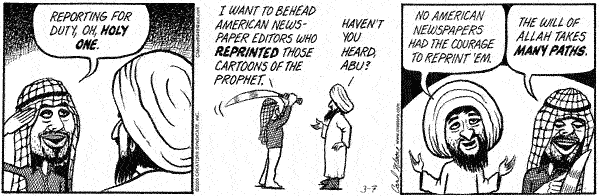
Or, ‘self prophetic’ as this cartoon puts it – brilliantly.


 I quite liked this one too.

But no, ‘judgement’ prevailed and we went with Brad and Angelina (I mean the Indian version – Abhishek and Aishwarya).


I think a cartoon commenting on the extreme reaction to the cartoons is definitely within the ambit of free speech. But given our country’s peculiar brand of ‘secularism’, even that is not a good idea…


You can see a bunch of brilliant ones - like this one - here.


Daryl Cagle has a great blog running on the issue as well, from a unique point of view. That of the professional cartoonist.

And now, some serious observations.

Hesham Hassaballa observed, "While I think it was wrong for the Morgenavisen Jyllands-Posten to publish those cartoons, it cannot be denied that newspapers in Arab and Muslim countries have published cartoons that were offensive to non-Muslims, especially Jews."


This is an important point. In fact, let’s look at the issue more deeply. Muslims enjoy the right to practise their religion in democratic societies such as Europe, USA or India. But wherever they are in a majority, people of other faiths must abide by their rules. And these rules have a religious basis.


And this extends to an extreme level, as this news report makes clear: Saudi Arabia police razes makeshift Hindu temple. RIYADH: Saudi religious police have destroyed a clandestine makeshift Hindu temple in an old district of Riyadh and deported three worshippers found there, a newspaper reported.
Members of the Commission for the Promotion of Virtue and Prevention of Vice, or the religious police, stumbled across a room converted into a temple while raiding a number of flats suspected of being used to manufacture alcohol and distribute pornographic videos, pan-Arab Al-Hayat said. A caretaker who was found in the worshipping area ignored the religious police orders to stop performing his religious rituals, the paper added. He was deported along with two other men who arrived on the scene to worship.

Frankly, I don’t even remember this news being covered in India, leave alone any protests. And to think that despite this kind of attitude we invited King Fahd to be the chief guest at our Republic Day parade.

In a multi-cultural, globalised world Muslim societies cannot expect other faiths to ‘understand’ their sentiments. Unless they take some trouble to understand and live in a spirit of tolerance with these other faiths. Or even dissenters within their own faith.


The harassment of Aligarh Muslim University student Farah Khanum was a case in point. Farah was threatened by a section of the AMU students, who claimed they were interpreting what is moral in Islam, says, “Over a period of time, they had been harassing me and demanding that I quit wearing jeans and t-shirt and don a dupatta.”

Newsflash: Every Indian citizen has certain inalienable rights and freedoms.

The Supreme Court ruled that Aligarh Muslim University – despite its nomenclature - cannot be given the status of a ‘minority institution’. Whichever way that controversy is resolved, the imposition of a dress code on the women studying at AMU would be unconstitutional.

Apply one standard!


Writing in the Los Angeles Times, Tim Rutten noted: Nothing ... quite tops the absurdity of two pieces on the situation done this week by the New York Times and CNN. In the former instance, a thoughtful essay by the paper's art critic was illustrated with a 7-year-old reproduction of Chris Ofili's notorious painting of the Virgin Mary smeared with elephant dung. (Apparently, her fans aren't as touchy as Muhammad's.)

CNN broadcasted a story on how common anti-Semitic caricatures are in the Arab press and illustrated it with -you guessed it - one virulently anti-Semitic cartoon after another. As the segment concluded, Wolf Blitzer looked into the camera and piously explained that while CNN had decided as a matter of policy not to broadcast any image of Muhammad, telling the story of anti-Semitism in the Arab press required showing those caricatures. He didn't even blush.

No Indian publication - with the apparent exception of the Patna edition of the Times of India – had published the original Danish cartoons. But one fine morning the Hindustan Times cheerfully carried a 2 column technicolour picture of ‘Bharat mata’ – the controversial painting by M F Hussain ‘depicting the nation as a nude woman on a scarlet canvas with Delhi, Mumbai, Kolkata, Gujarat and Goa inscribed across her body’.

No, it didn’t offend me – but the fact is some Hindu organisations had protested and the painting was removed from the auction. So technically, reproducing the image could have offended others. And printing the cover of this magazine could, as well.

In the same edition of the newspaper, Vir Sanghvi, editor of HT wrote: Of course we should be sensitive to religious sentiments. Of course we should try and avoid giving offence. But these are not absolute rules. If we do cause offence, then we are still within our rights as citizens of a free society to do so. And the people who are offended should simply avert their gaze.


I completely agree. But let this principle apply universally…


Breaking the silence as Mr Sanghvi notes : Liberal Hindus must end the double standard of the secular mindset and speak out as loudly against Muslim fundamentalism as they do against Hindu extremism.

If we do not do that, we discredit the whole concept of secularism. More important, we admit that our liberalism is not an absolute value but a convenient stick to beat Hindu extremists with while making shameful and unnecessary compromises with minority intolerance.

Well, I have taken his advice and added my voice. Please do not attempt to shout me down – as always, rational and well-reasoned arguments and comments are welcome!


And no, I will not 'balance' my views by also ranting against Hindu extremists in the same breath because that is irrelevant in the present context. I agree there could be things done which were not done ex refrence to the holy prophet. Though in the context of free speech, one cannot but agree with Mr Vir Sanghvi, one cannot understand why one cannot abstain from exercising such freedom of speech in matters of religion whatever religion it maybe when other avenues of creative expression are available. Why do something that is bound to be provocative and cause innocent loss of lives.


At the same time, the offended party must not overreact and protest in a civilised manner.

I find it easy to understand the why so many liberal Muslims are upset over the outrage because I tend to think like them. But to think the universe is made only of one set of people and only their views are the correct ones would be a mistake.


So I must agree with Hassaballa when he says that the caricatures of the Prophet were akin to publishing a cartoon of an abusive Christ.

I made much the same comparison myself with some Hindu deities, provoked by a sensible and controlled reaction to the cartoons that I saw in the Muhammad Ali area of Mumbai. Are the Muslims wrong in being upset over it? I think not. Their hurt is real and very understandable.

It's only fatwas that deserve to be condemned.

I think it is disgusting to see Muslim residents in Europe threaten those countries with violence and terrorism when those countries have been generouus enough to help many of them escape persecution in the countries of their origin and advance economically. They misused the freedoms that their democratic hosts have provided and used it to threaten, incite and provoke insane, abominal and absolutely unIslamic violence around the world.

And while there was an absolutely unnecessary morcha in Bangalore for an inconsequential thing that happened in a tiny newspaper published in a language that most Muslims don't know, you're right that there will be no protest against the religious intolerance of the Saudis against Hindus, Christians or even liberal Muslims that do not follow its puritan Wahabbi strain of Islam.

In the face of such remarkably insane behaviour by the followers of Muhammad, the saving grace for Muhammad's teachings is that there is a vocal group of Muslims that is standing up and saying enough is enough.
But that is the whole point why were the cartoons commissioned in the first place - The Bosten Globe did an excellent editorial on the issue.


Just like a Godhra is not a referrendum on Hindus in general, hardcore lunacy of one small section of Muslims too is not a true representative of reality. Of course, countries like Saudi have a universal 'ewwwie'ness (going by what some of my paki friends say). If you consider Religion's role as an Opiate, then Islam is what crack to a nigga.

Perhaps what the world really needs is more of "live and let live" and less of instigation & violence.

I have my complaints against Muslim extremism - especially those frankly stupid calls for Holocaust cartoons - but I also think that the Western media, press and blogs, have treated the whole affair rather patronisingly. The rights to be partisan and therefore express anything racist/sexist/anti-anything becomes our inalienable right, but I don't understand how a debate about free expression in the media cannot be tempered by a discussion about social responsibility. Cartoons about the Pope's edict against gay people or the pro-life fight in the States? Completely different, because there's a discernible debate raging around those issues.


I dont know why there was such a big fuss made out of a cartoon. Come on, no God is so small, that he gets pissed because of a cartoon. The funny part is, a Danish newpaper prints a cartoon of Muhammed there. All the way in Afganistan, people die because of the protests. Isnt that funny ??? About pseudo secularism in India, well, nothing much can be said or done. The minorities can be as fundamental as possible, but if something is done by the Majority, they say its very communal.

Reminds me of "Animal" the movie, where one of the character who is "Black" gets away doing watever he wants, coz he is black. [PS: that was a funny take by the movie makers. Well I feel that it is not wrong if cartoons make fun of a religion but they should not go out all the way to insult a particular sect. I agree that line b/w the two is thin but still..freedom of expression is important but so is respect for a particular religion. And I feel that the cartoons are well within the limits of decency. A nice work done by the cartoonist. The reaction of the Islamic world is totally uncalled for but in a way it was expected. Frankly speaking this gave publicity to the cartoons themselves. If the Islamic world hadn't reacted this way most of us won't have saw the toons.

I also condemn the brutal protests of Islam community over these cartoon issues. I think this points to the insecurity of the religion rather than the maturity of people embracing it. They are unable to come to terms with the contemporary world, they want luxurious lifestyle but when it comes to laws and rituals, they want to stick to their books. They need a self-introspection as to where they stand in the contemporary world. I felt that there are better ways of condemning and protesting instead of brutal bombings or torching of embassies. These point out to what extent they tread to let people know their voice. Holistic cleansing is what they need!!

Its sad that small things are considered a threat to such well established religions. Actually, more stupid than sad.


I believe freedom of expression should be used without hurting other people's sentiments. I dont see this whole incident as a controversy, I see this as a tragedy. Except the statements about the anti-semitic article published by Islamic newspapers. Honestly, that has nothing to do with this issue at all. If a Dane had murdered a Muslim, could he have justified it by saying that Muslims had murdered a Dane? A classic case of two wrongs making a right.


Freedom of speech is essential in today's society and if you start setting limits to it, the question is where do those limits end? Who decides what is right and what is wrong? That is why irrespective of whether it was provocative and caused a lot of destruction, the newspaper should not have apologized. However, there were was a valid statement of double standards that were raised by Islamic publications, about why Anti-Semitism is illegal in Europe (at least related to the Holocaust), and anti-Islamism isnt.

While I do not agree with Europeans banning anti-semitic speech and denials of the holocaust, on further examination, it is not the exactly same thing. In the case of the holocaust, the Jews were the victims, so anti-semitic speech is equivalent to the perpetrators of the crime ridiculing the victims. In this case however, most (if not all) modern terrorism is Muslims (a minority agreed,but Islam is the only common factor between them) hurting non-muslims, so it is a case of the victims satirizing the group whose members committed crimes against them.

Thursday, November 25, 2010

Jaana To Ek Din Sabko Hai, Hai Na?

I have been feeling a good amount of depression of late. Well, depression might be the wrong word to use, feeling low is more like it. This is not even remotely connected to my previous post on depression.

Remember those TV commercials in the good old days when a woman draped in a black sari would want to tell you something with that surreptitious look on her face and the I-wanna-tell-you-a-secret look in her eyes?

Mujhe aapse kuch kehna hai. Kaise kahoon? Un dino mujhe bahut dard hota tha. Bahut pareshaani hoti thi........
 
Mujhe to in dino bhi pareshaani ho rahi hai. Before you start getting ideas about the dard I am referring to, let me explain.

Aajkal ke zamaane mein?Of course I know aajkal ke zamaane mein being in touch is not a problem. Email and phone zindabad, and being net savvy, I am very much in touch with people, though they live in all parts of India and abroad.

But can anything compensate for getting to meet them and having a cuppa coffee or hanging out in the favorite food joints, with endless hours of senseless, itsy-bitsy talks about anything and everything?

It’s not that I would get to meet them everyday, or even every month. There aren’t many things I regret not having done in life. The one single thing that I do regret is that I did never get to experience hostel life. Of course I have been deriving a certain level of vicarious pleasure from friends who actually do/did, including my wife but that is beside the point. In hostels, you spend some 2-5 years together with hundreds of people, depending on the type of course you are into. You get close to a few, depending on the type of person you are. The level of doing-everything-together gets such that they become second family for you. And then one day your course gets over, you pack your bags, attend a few farewell parties, hug each other, and go your own way in life.

How many times do you get to see these friends again? Once? Twice? May be a handful of times? Assuming that they live in the same city that you do. How many times even then?

That is the way of life, that is how the world goes- that could be your logic. True. But that doesn’t dull the pain you feel to see your friends go away. It just can’t.

So when these people are all busy with their placements and getting their suits made and shopping for their new job and stuffs, I wonder if the pain would be worse than it was the last time?

For these are the friends I have laughed and cried with. I enter a certain restaurant to be reminded of the number of times I had been there in the past and had fought over who would pay for the food. I enter a certain station, to be reminded of the endless cups of coffee I had shared, debating on everything under the sun and seeing the trains leave one by one. I walk down certain streets, go to certain stores, and it all comes back to me again and again. I see the faces of my friends, smiling at me, waving at me, and it is then that I feel the loneliness.

And trust me, it is worse than seeing your beloved go away from you forever. For you know that your beloved loves you no more, and is gone forever, for good.

But these friends love you all the same, and stay in touch with you. You chat with them, email them, call them up, and this brings back the pain all the more.

Especially if you are in a cribbing mood like I am in today.

It is craziness to expect them to stay with you forever. Both you and I know that the world doesn’t work that way. But in their short sojourn, they leave behind millions of memories that make you so nostalgic.
 I still remember how I used to get late in Purohit's Cafe and how I would be undecided about what to eat (which usually would be a Masala Dosa). I still remember how I and my friends would make plans for the forest trips, which did happen twice.

Lots of memories. Fights about who would pay (actually not pay) the restaurant bills, cribbing about low mobile phone balances, bitching about the coevals and the profs, and of course the unanimous view of everyone that Udaipur is a very boring place to be in.

I hope that they are happy, now that they are gone from this city as I've too, where people take a siesta with as much of seriousness and regularity as Malaika Arora Khan does with her fitness and beauty regime, the place also being the quintessential example of bundhs and raasta jam and chaos and disorder.

Of course life goes on and you learn to live with everything. You go out and make new friends. And the cycle is repeated, you seeing them go away again and again. But that is the way the world works, isn’t it?

I know these are some of the best buddies I have had and they will be with me, no matter what. I can talk to them, meet them once in a while, email them and emaul them with the pathetic jokes I crack (okay, that was a poor one). But I can never threaten them with dire consequences if they cannot make it to the local food joint or the shopping mall at least once a week.

I still remember the day when I had been to see them off.

"You know what’s so good about marketing jobs? You get to travel to a lot many places. So you never know, by this time the next year, I might be in the same city once again."

It’s almost been fifteen long years.

Not that I blame people or end up feeling morose. I have learnt to take these things into my stride and appear unperturbed. Aakhir jaana to ek din sabhi ko hai, hai na?

And naah, I am not crying like that baby in the pic. It is just the thought of that injection tomorrow that’s causing the tears to flow.