Pages

Showing posts with label Cinema and Entertainment. Show all posts

Saturday, January 15, 2011

Sheela rivals Munni, others make music

By the time winter arrived in 2010, most Hindi film music lovers had only one question on their lips: Munni or Sheila? And it goes without saying that rhythm or melody had little to do with the interest. But the truth remains that these item numbers were among last year's biggest chartbusters and, judging by YouTube hits, also the biggest eyeball grabbers. Across the border too, they were talking points and news stories. Anorexic Munni raised Dabangg's repeat value, fleshy Sheela became the finest promo for Tees Maar Khan.

It's been said that Munni badnam hui was inspired by a timeless eastern Uttar Pradesh folk song. Pakistani's too stake claim that the original version belongs to them. But after listening to the track on YouTube one feels the Pak assertion appears as sincere as their stand on 26/11. The beauty of Munni lies in its lyrics; in its use of immortal expressions like Main Zandu Balm hui and Main cinema hall hui darling tere liye. And in the inspired selection of little-known singers, Mamta Sharma and Aishwarya Nigam, who bring a coarse, folksy edge that becomes the floor-scorcher's soul.
On the other hand, Sunidhi Chauhan's muscled voice matches the body tone of the playing-hard-to-get Sheila. But the lyrics, I know you want it but you're never gonna get it, seems to have been written for a risqué Bhojpuri number before being translated into English. But to move beyond these two tracks that have received disproportionate media attention, Bollywood 2010 has reaped a fairly fecund musical harvest. Among the year's most innovative track is Dil to bachcha hai ji (film: Ishqiya). Many years after penning Dil padosi hai, Gulzar's new simile for the heart is endearing, and in the context of the movie's aging protagonists, wonderfully apt. Rahat Fateh Ali Khan's rendition is different from anything he has done before. What stays with you long after the song is over is the sound of a wailing guitar with a Spanish feel and the dull ache that often comes reminiscing unrequited love.

Then again, two tracks from Once Upon a Time in Mumbai (music: Pritam) stand out for their melody. With his moody rendition of Pee Loon, Mohit Chauhan again demonstrates how he has matured as a singer from his Silk Route days. There's an emotional honesty and intensity about his singing. Tulsi Kumar, late music baron Gulshan Kumar's daughter, miraculously manages to hold her own against Rahat Fateh Ali Khan in Tum jo aaye, a delicate romantic duet with a neat melody line.


But perhaps the year's most imaginative music came from Amit Trivedi, the 31-year-old composer who sprang to prominence with Dev D (2009) and got the National Award for its music this year. In 2010, Trivedi composed music for Udaan, Aisha and No One Killed Jessica (to be released this year). Few new millennium Bollywood composers have been able to create music that blends with the film's situation so beautifully as Trivedi. Not all his compositions are hummable but listening to them is like taking a guided tour through the film's emotional landscape. In Udaan and No One Killed Jessica, lyricist Amitabh Bhattacharya provides him first-rate support. Just listen to Naav (film: Udaan) and Aitbaar (film: No One Killed Jessica) and you'll see what one means.

Sunday, January 9, 2011

Sheela Ki Jawaani


The song is an item number by Katrina Kaif  for Farah Khan's "Tees Maar Khan". It has a different feel ,which viewers would have never seen before. Kat will be seen in 6 different shades in this song and more special about this song is its last sequence - a rustic bar setting.

This bar part is dedicated to the song ‘ JUMMA CHUMMA DE DE’. It was the blockbuster song of Big B in ‘Hum’. Few of its lines are included in the last part of ‘sheela ki jawani’. Also Kat is surrounded by men holding beer-mugs and ever ready to splash water on her.

Another part of the song is a tribute to the musical Chicago. The song itself is a mix of Bhojpuri meets Bob Fosse.
 
The most awaited, seductive Kat is out there to entice you for her next release and its non other than Farah Khan’s Tees Maar Khan starring Akshay, Katrina and Akshay Khanna.

The moves and the styles of the Kat in this song are definitely incredible and she will earn a big round of applause after her best dance performance of the year.

With the moves shown – its proved that Farah Khan can make anybody dance. Its the best dance Kat has given ever in Bollywood history. 

The song was released as “the most awaited sizzling, sexiest, seductive item song of the year.” So, when Kat dances a la Shakira or Madhuri Dixit, mercury levels are going to go through the roof.

For Sheela Ki Jawani, she donned six looks, from performing jumma chumma in ghagra choli to a modern gal dressed in an enticing white shirt and black hat. Later conman Akshay Kumar too joins her in the song.

Who else but Sunidhi Chauhan could sing Sheila ki jawani..
Farah says, “Sheila Ki Jawani was supposed to be a raunchy item Bhojpuri kind of song as Katrina’s a wannabe actress acting in sleazy films but the song shaped out to be classy and a mix between Chicago and Broadway. I have never seen Katrina looking both hot and sensuous at the same time. In her earlier films, she’s dressed mostly like a Barbie doll Farah added, Katrina really trusted me and didn’t argue even once when I told her what she had to wear. She just told me that she needs to start working out and tone her body more.Her dedication is tremendous. She didn’t feel awkward with so many men around. The more they screamed and cheered for her, the more she got a high and her energy levels increased.”

Director/Choreographer Farah Khan renowned for capturing actors at their glamorous best made Kat give Shakira a run for her money. The song titled “Sheela Ki Jawani” saw Kat belly dancing much on the lines of Shakira videos for which Farah Khan had flown down one of the world’s most renowned trainers from Brazil. Talking about Katrina’s hottest song yet said Farah “You will see Katrina in an all new avatar. She has never looked this hot. Audiences are in for a treat." Kat worked hard on her physique and adhered to a special diet for the song.

Revealed a production source “Farah is known for creating iconic film songs. She revealed Shah Rukh Khan’s six packs in Dard-E-Disco and this time round she is going to exhibit to audiences Katrina Kaif’s hottest side yet as she gyrates to the song Sheela Ki Jawani.”

Earlier she was voted the “Sexiest Actress" by London Eastern Eye and featured second on the “Top Online Newsmaker of 2009” list by Yahoo.
'Sheela Ki Jawani' to rule roost in Surti Skies this Uttarayan

SURAT: 'Sheela Ki Jawani' will dominate the diamond city skies this Uttarayan. Competing with another bollywood hit song 'Munni Badnam Hui' by Maliaka Arora-Khan and Katrina Kaif kites are in hot demand this season.

This time though, the kites are up to 40 per cent costlier and Surti manja rates are up by about 25 to 30 per cent. A wholesaler of kites in Bundela Wadi Yogesh Telwala said, "As the goods are in short supply, the market is hot. We have received 25 per cent less stocks than last year. Delayed monsoon extending till Diwali has ruined kite making to an extent and not many have a huge quantity to sell. Moreover, rates of paper and sticks have also gone up, so we have no option but to sell kites at higher rates."

However, the manja market is very dull and there are no buyers. Manja makers of the city have not increased their rates of making a manja, but all types of bobbins are costing at least 25 per cent more so the effect is passed on to the customer. As a result, rates are up by 25-30 per cent when compared to last year.

Dipak Saddiwala of J Bhagwan Manja said, "We have no buyers, but there is a reason. School exams have begun today and many students will think of Uttarayan after that. We expect the sales to pick up in last five days like previous years. I feel real sales would begin by weekend." He also added, "We have not increased our manja making rates and they continue to be Rs 20 for 1,000 yard bobbin, Rs 50 for 2,500 yard and Rs 100 for 5,000 yard bobbins."

 "Whatever be the rates, Surti's fly kites worth nearly Rs 5 cr on every Uttarayan, " said Topiwala, who is used to a huge last minute sales of kites.

Anyways, this year let's see, who will rule the roost - Munni or Sheela

Monday, December 27, 2010

Aamir ko gussa kyun aaya tha ??

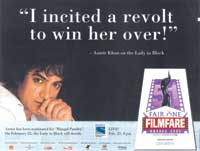
 Aamir Khan sued Bennett Coleman, publishers of the Times of India and Filmfare magazine for running this ad using his photograph and a 'quote' without his consent. Aamir demanded Rs 21 crores and an apology.


A 'close associate' of the actor told Midday: "One can’t attribute quotes to someone or use his picture to promote or endorse something without permission... After all, they are cashing in on his reputation and image, and he has the right to choose what he endorses."


And Aamir would never endorse the Filmfare awards because he 'does not believe in awards'. Or any others, for that matter except the National Awards. And, I guess the Oscars.

This, I think, rankled the folks at Filmfare. Other stars were featured in the series of ads but note how staid the copy was. Woh to award lene aayenege, unhe naraaz thodi kar sakte they....

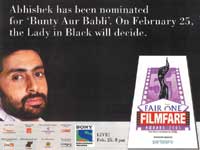
The one with Amitabh read: Amitabh Bachchan has been nominated for 'Black'. On Feb 25, the Lady in Black will decide.


And the copy in Junior B's ad was identical! Abhishek has been nominated for 'Bunty aur Babli'. On Feb 25, the Lady in Black will decide.


Had they similarly written 'Aamir is nominated for 'Mangal Pandey' I doubt the star would have bothered to sue them. But implying he 'incited a revolt to win over the Lady in Black' (the Filmfare statuette) is a bit over the top.

I think if an actor does not believe in awards you should respect that and not nominate him in the first place. Organisers, please keep this in mind next year - there were other fine actors in Rang de Basanti besides Aamir.

But of course if it isn't a major 'star' the nomination will only be for 'best supporting actor'.


Besides, that year saw both Karan Johar and Rakesh Roshan releasing films which meant the competition would be Shahrukh vs Hrithik.


And oh, KJo's film also featured Amitabhji and Abhishek.

I simply don't understand the logic here. Just because Big-B and Little-B didn't have a problem did it mean everyone else shouldn't? This is the chalta hai attitude we are notorious for. Bennett and Coleman was not the roadside paan-wala dukaan to slap an image of XYZ chewing paan. Aamir was being a thorough professional and there was absolutely nothing wrong with it. That wasn't about money. This was about pissing off people who took others for granted.


I think that Benett & Coleman tried to take mileage of Aamir, the person whom the country knew. If he did not want to be in any ads without his permission, that needed to be respected by TOI.


In all fairness, this was a very silly thing. Why should we all waste our energies in either supporting or speaking against TOI. Both of them gained a huge lot of internet space anyway.


Sigh! Wish more stars would revolt against these 'I Love You-You Love me, We're One Big Happy Family' series of awards...

Wednesday, December 22, 2010

The silence of the truth

Still Voices, Tamal Sen's diploma film from the Satyajit Ray Institute looks at freedom of expression in the world's largest democracy, showing how it is suppressed in the name of the larger good.

CBI internal investigator Jaidev Mishra is assigned the responsibility of investigating the sudden death of Nemo, a suspected Naxalite. As part of his investigation, Mishra comes to interview Arunima Sen, a reporter with a Kolkata daily and former girlfriend of Nemo. His investigation reveals that Nemo was shot down deliberately by two encounter specialists without being given a chance to defend himself. He did not have a criminal record. Nor was he carrying a gun. 

But Mishra's boss asks him to change the report. He tries to convince him that Nemo was shot at because he had fired the first shot at the police. The boss adds that releasing Mishra's report would hamper the prospective compromise between the Establishment and the Naxalites who had agreed to negotiate with the former. Mishra is shocked because he has already discovered the truth. Not only was Nemo unarmed, but he was also left-handed whereas the reports showed one gun having been fired with the right hand. He changes the report but later ensures through a different route that the truth will finally find its way. 

Still Voices is Tamal Sen's diploma film for direction from the Satyajit Ray Film and Television Institute, Kolkata. Through a very powerful sound track and imaginatively designed visuals, Sen points out how diabolically the citizen's fundamental right to freedom of expression is manipulated, censored and silenced by the Establishment in a country that prides itself on being the world's largest democracy. Subjects like the manufactured killing of a suspected terrorist by the police aren't usually the stuff of one's diploma film. Perhaps a choice like this reflects the pessimism of the younger generation of creative artists, asking "Where has love gone?" 

The 25-minute film has been nominated for Best Narrative Short at the Flint Film Festival, Michigan, USA. It also received five nominations ((Best Student Short, Best Editing, Best Production Design, Best Actor and Best Actress) and won the Honorable Mention 4th prize at the Los Angeles Reel Film Festival. It has received a Special Mention Critic's Prize at the 58th Columbus Film Festival, the oldest film festival in the North American continent. It has been chosen to be screened in the competitive Student Film Section at the Goa IFFI this year. 

Explaining what motivated him to deal with such a political statement in his diploma film, Sen says, "the political backdrop of the story provides context and grounds it firmly in this time and place. Take out the details, and you have the beginnings of a story that could be set within any time in history. The film's tagline 'The first casualty of war is truth', a quote from the Greek playwright Aeschylus, reflects the universality of the theme. At the time I was fleshing out the story, there was a tribal uprising in the village of Lalgarh, 96 miles from my hometown. The rapid industrialisation in other areas combined with long term neglect of tribals in Lalgarh had far reaching effects and fostered a sense of alienation. My film bears this out." 

Why did he make a straightforward feature film when most students of cinema try to experiment and explore anti-narrative forms of expression? "As a student of cinema, I could discern the clear divide between mainstream and art house cinema in India. Mainstream films rarely pick topics which reflect real life situations while art house films seldom manage to attract mainstream audiences. I saw even fewer student films that managed to bridge the gap between the two. Shoestring budgets play a very significant role in this, pushing most subjects out of our reach. The budget also affects decisions made on the aesthetics, influencing the film from the ground up," explains Sen. 

Still Voices is the story of three people, linked by a series of events, each driven by powers beyond their control, trying in their own way to wrest some control back into their lives against impossible odds. Nemo's traumatic past puts him on a path that rarely ends well, while all Arunima wants is closure after knowing the truth. As the only eye witness to the incident, she is absolutely certain about Nemo having been unarmed when the encounter specialists grabbed him. Jaidev wants to report the truth, but his upper echelons suppress him, emphasising the larger good at the cost of the truth.

The defining event of the narrative, using only sound on a black screen, begins the film - in a sense, a parallel to how the public remains mostly unaware of the truth. 

The film opens on a black screen with sound metaphors of chasing footsteps and heavy breathing filling the soundtrack, suggesting the presence of the killers and their victim. This is followed by the screeching tyres of a braking car punctuated by the sound of birds suddenly taking flight. The screen comes alive with granular Black-and-White shots at this point, and soon fills up with confused images of people running here and there, then walking towards the centre of a Kolkata street to stare at something lying on the ground. 

We hear the sound of three gunshots and the screen now changes to colour focussing on a pair of jean-clad legs lying prone on the street, a trickle of blood unfolding the tragedy of a death untold. As Jaidev Mishra sits down to interview Arunima Sen, the story flashes back and forth through swift cuts between Arunima's narration in the present and its picturisations in the past. Once the scene shifts to the interview, the film becomes more dialogue-centric than action centric till Arunima and Nemo go to the restaurant for lunch. 

"The challenge was in creating a narrative that encouraged understanding and prompted debate about the consequences of our actions. We were conscious not about choosing sides, but about our wish to explore the lives of the people directly involved," informs Sen. The editing and the soundtrack are the two powerful 'voices' in the film alongside the full-blooded presence of the two actors who portray Mishra (Gaurav Dwivedi) and Sen (Paru Gambhir.) 

Dishari Chakraborty's musical score uses the beat of rhythms more than melody and this adds to the air of suspense. Still Voices carries the professional finesse that comes from experience. Manas Bhattacharya's cinematography explores the graininess of Black-and-White and sets this against the soft pastel colours lit softly in Arunima's room juxtaposed against the dimly-lit shots within the restaurant. The editing by Sudipto Shankar Roy and the sound by Sudipto Mukhopadhay compliment the narrative and its unfolding. The film closes with the same Black-and-White grainy shots, elaborating the reality of what actually happened left hazy in the opening scenes. 

Still Voices throws up a microcosm of the reality that exists in the country today where voices are stilled, rebels are shot down without a trial, entire families are killed through terrible errors of confusion by the very people who are paid to protect lives. 

"I wanted to show that in the never ending battle for political power, truth is always the first casualty. The main purpose of this story was to portray the convoluted and dangerous world of politics, to highlight the lives of people who unwittingly become collateral damage in other people's aspirations, and finally to ask ourselves what difference a single man can make when the System itself is broken. Some of the audience members at previous screenings thought that the ending was too positive for the stark reality that the film was highlighting But this was a conscious decision. After all, we want our heroes to redeem us, to show us the paths that perhaps we are too afraid to take," Sen sums up. 
 

Monday, December 20, 2010

SRK features in WikiLeaks cables

Bollywood actor Shah Rukh Khan and the threat by the Shiv Sena to ban screenings of his film "My Name is Khan" found mention in a US embassy cable that was leaked by WikiLeaks.


"My Name is Khan" is a 2010 movie made by Karan Johar in which Shah Rukh Khan and Kajol played the lead roles.


"The Shiv Sena had threatened to ban screenings of Shah Rukh Khan's upcoming movie, 'My Name is Khan', because Shah Rukh Khan publicly lamented the absence of Pakistani cricket players in India's professional cricket league for the coming season," says the cable dated Feb 22, 2010.


The cable posted in the Guardian newspaper said that Shiv Sena goons burnt posters of the movie and protested in front of his home, asking Khan to "move to Pakistan".


"Khan himself did not bid on any Pakistani players as co-owner of one of the frachises," it said.


While some theatre owners refrained from screening the film on its opening day due to security concerns, "a show of force by the police convinced theatres to roll out a full release" the next day.

  "With protests and controversy generating far more international buzz than the typical Bollywood movie, Khan's new movie opened to packed audiences in Mumbai and elsewhere," it added.

Thursday, December 16, 2010

Sa Re Ga Ma Pa And Then What ?

Brij Mohan Lall Munjal of Hero Honda Motors has several accolades to his name. They include a host of richly deserved lifetime awards for his contribution to Indian business. As an entrepreneur, he's put India on the world two-wheeler map. He gave Rahul Bajaj a run for his money. He's also somewhat reserved, not one for limelight. If he wanted to, he could have sought and got a greater personal profile. He's avoided it deliberately. That's the impression he conveys when you meet him as well.

Yet, the other night, he was on stage announcing the winners of one of the country's biggest singing competitions. This was live and past midnight. He was looking reasonably energetic. The event was taking place in a suburban Bombay stadium. He gave an appropriate but quick backdrop to the competition. He reeled off the numbers and then went on to announce the results. "And the winner is...," he said, waiting for perhaps 30 seconds or more, knowing the nation was watching spellbound. Then he revealed the name.

He didn't stop there. He said he had followed the competition closely. He even offered words of fatherly consolation to the singer who came second. Something to the effect of him having captured everyone's hearts. Munjal didn't fumble for words as often people in gatherings like this do. Particularly sponsors. Perhaps its the confidence that comes from owning the event. And yet, this was not the indifferent, eyeball focussed sponsor striding in to claim the glory. It was someone who had plugged into the drama, right from the beginning. Or along the way.

All This For A Song ?

All this for a song. We all like heroes. We like to align with some. Because they are underdogs. Or they are good. Or they belong to an economically disadvantaged region. And yet, there is something troubling about such a song and dance. About a song. Sure, it represents something more. The rise of the underprivileged. The tryst with glamour and Bollwyood. For someone who was a civil engineer with the state Public Works Department (PWD), its a long journey. And he's honest. I've heard of PWD employees who hold two jobs.

Despite that, its baffling. Do we like such contests because they are a true representation of people's power. And perhaps hard merit. Because merit or votes do not work elsewhere, or in most places. Like the political process where your votes don't necessarily swing what you want. Some 55 million SMSs were received. Depending on the double-counting, anywhere between 5 million and 10 million people voted. That's more than 10 per cent of the mobile phone population of the country.

I don't think that many mobile phone owners turn out to vote for politicians. But they do it for aspiring playback singers. Who will not necessarily do better than someone who has not risen through the competition route. Quite the contrary, one feels. At least so far. Kudos to them in any case. They've worked hard to reach where they are. And Munjal ? Well, he deserves the returns for the money he's invested in the programme. And the rest of us ? Could we also find something a little more productive to do ? Like also vote for a better quality of life ? 

Finally Debo jeet gaya

...And here are some observations about reality show finales -

- Approximately 1 hr and 46 minutes will elapse between the time the host first announces, ab kuch hi der mein aapko hum batayenge ki 'India ki voice' kaun hai... And the actual announcement

- That a 'chhota sa break' will last for 6 minutes and 21 seconds. After all, the channel has to make hay while the TRP shines (and make up for several low years)

- That the final two are completely unrecognisable from their original selves thanks to 'make overs'. (A sign of having well and truly arrived is that you are now no stranger to the world of streaking and hair colour!)

- That every time a personality who is at least 5 years older than the contestant the simple rule is: lunge for their feet. They may claim to hate this but... Why take chances.

- That with all the mutual backscratching going on, every major and minor personality called on stage is going to have no back problems - for some time to come.

- That you can call a show that is telecast with a 2 hour delay 'live'...

In addition, specific to the Zee show 
- The announcement of results resembled an annual school Sports Day function with the number of wellwishers, hangers on and actual stakeholders crowding onstage at the very end.Even Brij Mohan Munjal as he announced results of the 'kumptition" reminded me of an avuncular old school principal.

- That in the end I have this teeny weeny doubt about whether Assam and NE really did manage to swamp the voting earlier. In the end Debojit won by a slim margin of 50.42%.

Yes there are supposed to be auditors but... Didn't it make for a much bigger 'story' this way?

As close to 5.5 crore votes were cast and that's a cool Rs 30 crores plus which goes into the pockets of Zee + Cellcos. Controversy sure helped to fuel those numbers!

- Noted in the closing credits two gentlemen under the heading 'Reality Director'. What exactly do these people 'direct'? How to pit one kid against the other - and other such spontaneous events?

- For the first time I heard both Vinit and Debojit - I think they're both competent singers and I have no problem with Debojit winning. He deserved it as much as the other finalist.
 
But it was Himani who I think was truly outstanding and as Alka Yagnik said, she will go a long way. I never saw any shows with Nihira or the others so I cannot judge how good they were but I have no doubt in the long run (say 5 years from now) the 'winners' of these reality shows may not achieve as much fame and fortune as some of the others who also competed.

Already, it is clear that Qazi - who was a great performer in the context of Fame Gurukul - cannot repeat his magic outside the sets. His first video was a disaster thanks to lack of singing talent, atrocious dress sense and endless narcissism which was irritating rather than endearing.

I think the Sa re ga ma winner and also-rans fared better because the show roped in so many big names from the world of music as mentors. And they promoted their personal favourites - which outside of the show format was a good thing.

What i felt was that reality TV is a niche in Indian market and it needs to be filled - so the promoters will play with it and use the hype to generate big bucks. As for the participants, it is better if they can find mentors because most of them are good - have watched a couple of episodes. And 5 yrs down the line - only the 1s with will & humility will shine through.


We are such regionalistic w****s. I really don't see the point of India continuing as India. Ganguly gets chucked out of the team, and all of West Bengal cries foul, curses the rest of the country, and wants out. We have a singing competition, and most people vote for their home-boy, not the best. Like Debojit was going to donate all his money to help the state fight its terrorism issues. The South will always be the South, never part of India. Punjab has already fought for its 'freedom'. Kashmir is halfway there. Pakistan, and Bangladesh are there. Mumbai wants its own independent economy. States cannot live with their neighbors. They cannot live peacefully with themselves. They fight with each other over water, and they split up.

Oh well, ignore all that. Come Budget time, and its all Hum Ek Hain.

Unlike the old days when big singers and composers zealously and jealously guarded their own territory, the new lot has (willingly or unwillingly!) accepted the recognition and promotion of young talent as part of their portfolio. It's no longer seen as a personal threat.

More talent, more variety, more voices - we as audience could not ask for more!  

Reality Bites

In 2005, the whole of India was talking about Indian Idol. Abhijeet ya Amit. Why was Rahul Saxena eliminated. And so on and so forth.

Then, in 2006 Idol had been quite thanda. An online poll threw up some startling statistics. 82% of the people who took the poll said they had not seen a single Indian Idol episode. 13% said they had seen a few while about 5% were avidly following the show.

An Optimum Media Solutions report noted that in 2005, the 7th January episode of Indian Idol notched TVRs of 6.8, while the 5th March finale saw a surge in the ratings to a whopping 15.3

In January 2006 Indian Idol 2 ratings were on an average a miserable 3.31. A host of stars had been roped in to add 'buzz' - the latest being Will Smith. But it seemed like too little, too late.

Sony Television took it for granted that we would tune in to Idol part 2. The promotion and build up this time was pretty low key. Plus, in the meantime they flogged the vapid Fame Gurukul which threw up a joker of a winner in Qazi.

The dark horse
And what they had not counted on at all - Sa re ga ma pa Challenge from Zee TV. The once staid show decided to go the SMS way. In addition they introduced the concept of music directors acting not just as judges but mentors with the creation of 'gharanas.'

These moves had been controversial (loyalists said the show was better in its unadulterated format). And they had created controversy, which is always a great boost to ratings.

Sa re ga ma not only achieved a TVR of 3.53 in Jan 2006, it outdid Indian Idol in the buzz factor.

The drama so far: One of the judges Ismail Darbar staged a walk out. Then the contestants staged a walkout

The core issue had been SMS vs Talent.

Darbar was peeved when his favourite Nihira was voted out by the public.

Can't people recognise quality when they hear it? Just because Nihira can't wear revealing clothes or dance, should she be eliminated? Is that how we have ever judged our greatest singers, like Lataji?
Darbar later returned to the show - many cried this was a mere publicity stunt.

Then Himani, Hemchandra and Vinit staged a walkout claiming they had been threatened by ULFA militants who supported the 4th contestant Debojit. They too returned to the show. But the issue of Debojit proceeding into the finals based on a huge number of regional votes had caught fire...

 Sa re ga ma pa? Na!
Here's my take on the subject, elaborated - The ‘finals’ of any sporting event is fraught with glorious uncertainty. Anybody can win. Even if the contest is lopsided, even if one team is far more fancied than the other. Upsets can and do happen. And that’s why we tune in.

The finals of a ‘reality show’ however, are quite a different story. But no matter how well 17-year-old Vinit sang, the result was a foregone conclusion. His rival Debojit had been getting a record breaking number of SMS votes for many weeks. Nothing was wrong with that, except that 80 per cent of those votes came in from Assam. And Debojit was Assamese.

I’m not saying Debojit was untalented. But was he the most talented? We’ll never know, because a huge number of people were choosing to vote not for ‘India ki Voice’ but ‘the boy from Assam’. Without giving the other contestants a fair hearing, a sporting chance.  


In that sense, the show was truly a mirroring reality. India voted for its singers the way it voted for its politicians! Merit mattered less than the fact that the candidate was from my mohalla/ community/ state.

The reactions
One person wrote in to say:

I completely agree that in Saregamapa the voting pattern for Debojit was somewhat not acceptable as he was getting the votes mainly from the Northeast region and not from the whole of India. But why single out Debojit? What about the others?

Basically at the end of each show every contestant used to request his/her home state to specifically vote for them . It is another story that the response was not so overwhelming everytime as in the case of Debojit.
  

The fact is for all reality shows like this the home state always plays an important role in a contestant' s win or lose.. Again on the other hand contestants from the South never got any votesfrom their home state because people from the South do not watch Hindi programmes. In a country as diverse as India if diversity plays such an important role in hampering someone's ambition and hope then there is no bigger tragedy than this...

A valid point. Women were not considered 'talented enough' to play in orchestras. When the auditions were held from behind a screen, where the performer was not visible, the percentage of women musicians in orchestras went up quickly from 5% to 50%!

This is an example used by Gladwell in his book 'Blink' which looks at the complexities behind snap judgements. In the orchestra case, the maestros would have been entirely unaware of the flaws in their judgment. They would have been outraged at the suggestion that their decision-making was compromised by sexism.

Now theoretically we could put all participants behind a screen and let people vote for the best voice. But then it would be a radio show, not a TV property.

While Zee could not have engineered votes from Assam (that happened spontaneously) they had certainly capitalised on it by announcing the same on every episode...
 
What could have been done
Another gentlemen sent in a sensible suggestion:
Even in the Olympics, when multiple judges are giving marks to contestants, the highest and the lowest mark givers are eliminated and an average of the rest of the marks are taken. This is done to remove any bias a judge might have for or against any particular contestant. The same could have applied here.

The votes from the state giving the highest and the lowest votes should have been eliminated and then the average should have been taken.


Magar phir wahi baat hai - show mein spice kahaan se aata.
Aur na aise strange replys aatey: " It is an article written by an idiot. I am astonished... Use your brain. Is Assam a part of India or what? For people like you the North East is always sidelined. Rubbishhhhhhhhhh."

I'm sorry but the conspiracy theory does not hold

The Indian government has made a mess of the North East situation, no doubt. But I and millions of other Indians think of Assam as just another state in the Union of India. We do not vote for Assamese singers because we are against their place of origin.
 
Many of us simply don't want to waste 6 bucks. For any singer, from any region.

Bottomline: Ultimately, the feeling is that neither Vinit nor Debojit deserved to get so far (Himani, Nihira and Hemchandra were more talented). Those who had been following the show said Vinit too garnered votes through means other than pure talent (apparently by making up some stories about a 'lady love').

But hey, these are 'reality' shows and the reality is that people want to discuss how unfair this one's elimination was and how badly that judge behaved. Because these are 'hope operas'.

And whatever the means a contestant can use to awaken emotions enough to vote for him - he or she uses. That's the way the show is designed.

India seems to be finally maturing the Western way. It is interesting to note that these shows are finally emulating the Western model where a star (performer of any kind) has to keep himself/herself in the news to sell oneself. The definition of fittest (as in survival of the fittest) has changed from creatively talented to famous. Roughly translating from a hindi saying: If you are infamous, you are indeed famous.

This also reminds me of a test that was conducted some 10 years back in the USA where in a movie theatre featuring a suspense movie, every 10 minutes, for 1 second, a Coca-cola ad would turn up. People were furious with Coca-cola as its advertisment interrupted the movie, but after the movie was over, the sales of Coca-cola from the shops sky-rocketed suggesting that these things work at subconcious level.

At the end of the day, no one really loses. Most reality 'stars' end up earning big bucks through playback singing and live shows. Instead of struggling for years and years like the singers of a previous generation. And simply for that, I say, these shows raining down on us are a good thing.

Life is not fair - that is reality. Neither are reality shows which are actually not real at all...  

Tuesday, December 7, 2010

Munni badnaam hui, darling tere liye, Main Zandu balm huyi, darling tere liye


Favourite taunt of Pakistani politicians!
Islamabad: Now " Munni badnam hui" has found a place in the political circles of Pakistan with politicians from leading parties using the hit Bollywood item song to take a swipe at one another.

Speaking at a party function a couple of days ago, the ruling Pakistan Peoples Party (PPP) leader Imtiaz Safdar Warraich said: "We are being blamed for the wrong doings of others." In an obvious dig at the opposition, Pakistan Muslim League-N (PML-N), he said: "Our situation is such that we can only say, 'Munni badnam hui darling tere liye'."

Pakistan's Punjab province Law Minister and PML-N stalwart Rana Sanaullah was quick to latch on to the opportunity. "What a pity that the PPP leader has termed the entire party as Munni," he said, adding that "this Munni is not getting a bad name because of darling but because of her own actions".

This is the latest reflection of the popularity of the Bollywood song picturised on Malaika Arora in the movie " Dabangg".

There's a play called "Munni Badnam Hui" that's being used to spice up TV scripts and wedding revellers are dancing feverishly to its tune.

The song has become a rage in Pakistan. In fact, Malaika has almost become a household name in Pakistan after the song composed by Lalit Pandit.

No wedding or function is considered complete without the song. It also blares from audio systems in cars and music shops while FM radio stations are swarmed with requests to play the song.

However, the song has created problems for the real life Munnis in the country. Munni, a mother of two from Lahore, has been harassed so much that she has shut her small shop. "Every now and then someone will come to my store and say 'Munni badnam hui darling tere liye' in front of my customers. First, I didn't pay much attention and tried to ignore it, but then it became a routine event and I started to get irritated, Even sober and reserved people have sung this song loudly while passing by my store. I have scolded many of them but they just laugh and run away. Finally, I couldn't take this behaviour anymore and closed my shop for several days. Munni said.

This Munni is not the only one to face problems. Shahida Munni, principal of a school in Lahore, had been given the nickname Munni by her family and friends. "While walking in my neighbourhood, I am always scared that someone will start to sing the song. Most of the time my fears become reality as many boys either sing the song loudly or play it on the stereo!" Shahida said.

Sometime back I got chatting with an ex-colleague who thought that the recent hit number "munni badnam hui darling tere leeye" was a rather cheap number. Just to divert a little from the topic. As one of my friends had earlier pointed out, the original from which munni badnam hui has been copied is "Launda, badnam ho GAI naseeban tere liye" and NOT "Launda badnam ho GAYA..." as mentioned in the press. It is "Naseeban"(girl) addressing the guy "LAUNDA" and lamenting that she became "badnam" for him.

Of course I did not agree with his rather 'grotesque' description of what I think is a good fun song.

The reason for not agreeing with him was very simple. Anyone who was growing up during the late eighties and the early nineties, and is familiar with the kind of songs Bollywood produced during that period, will definitely vouch for the fact that "munni badnam hui" is a rather tame number in comparison to the kind of stuff that was produced back then.

So here is a list of what I think are the famous double meaning and raunchy songs that the Hindi film industry has managed to produce over the years, and the multiplex generation has never heard of. Of course this is not a complete list, so please feel free to add to it.

It all started with the pelvic thrusts of Madhuri Dixit in "Choli ke peeche kya hai." Now don't ask me what Neena Gupta was doing in that number. But this Anand Bakshi song, sung by Alka Yagnik and Ila Arun had the front benchers absolutely in raptures.

Immediately after this Varsha Usgaonkar tried to match Madhuri's pelvic thrust for pelvic thrust in the rather more direct "Choli ke andar kya hai." Of course, the song did not get anywhere, one Varsha was no Madhuri and two it was a tad more direct with lines like "Choli ke andar tabahi hai tabahi tabahi", leaving nothing to imagination.

Mithun "Ooty" Chakraborthy soon latched onto the trend and starred in the mega hit "Chadh gaya upar re attarya pe loutan kabootar re", more famous as "gutur gutur". Govinda and Karishma Kapoor really cashed in on this market. Govinda even went to the extent of singing "Meri pant bhi sexy meri shirt bhi sexy...". The censors let this one go, but would have none of "Sexy sexy sexy mujhe log bole" starring Karishma, which was eventually toned down to "Baby baby baby mujhe log bole". Of course the movie Khuddar (which also starred Govinda) tanked.

But nothing matched the brilliance they achieved together in "Sarkaye lo khatiya jaada lage" from the movie Raja Babu. I remember watching the movie at Chetak Cinema in Udaipur (Rajasthan). The crowd which had come to watch the first day first show was in fact disappointed. This is not what they expected from the David Dhawan-Govinda combination on a roll with a string of hits in the early nineties.

And that was till the last song of the movie "Sarkaaye leeyo khatiya jaada lage", started. The theatre had never been so loud. Every time, Karishma Kapoor lifted her red lungi to expose, the crowd simply went berserk. Miss Kapoor during those days was climbing the popularity charts and was willing to expose, if the script so demanded.

Of course such brilliance and titillation had never been achieved before nor would be achieved after this.

David Dhawan tried repeating it with Rishi Kapoor and Juhi Chawla in Eena Meena Deeka with the song "Saiyyan ke saath maddaiya main bada aaye rajjeyya main". The movie also had another song called "Towel main bahar jaogi to hulla mach jayega". Both the songs did not work. Well Rishi Kapoor was no Govinda and Juhi no Karishma.

Dhawan tried this again with Anil Kapoor and Juhi Chawla in Andaz. It had two songs. One was,"Main maal gaadi tu dhakka laga dhakka laga bhai dhakka laga" and the other was, "Khada hai khada hai khada hai, dar pe tere aashik khada hai khol khol khol, darwaza khol". Both the songs were cleared by the Censor Board, but the stunt did not work for Dhawan and the movie flopped. Guess by this time, people had already started to tire with such songs.

Ajay Devgan tried to mix cricket with a double meaning song. "Kal saiyyan ne aisi bowling kari, ek over bhi main khel payi nahi, chouthe hi gend mein out huyi, paanchava gend main jhel payi nahi" was a song in the 1994 movie release Vijaypath. Well the Intermediate Science Classes at St Xavier's College were empty the day the movie released, everyone having gone to watch the song at the theatres. Much to their disappointment the Censor Board did not let the song go and had it cut from the movie. So that was that.

Akshay Kumar and Mamta Kulkarni had their share of fun with "Bholi bhali ladki khol de re dil ki pyar waali khidki" and "Bharo......maang meri bharo" in the super hit Sabse Bada Khiladi (which was in fact written by Hindi pulp fiction writer Ved Prakash Sharma).

Mithun Chakraborthy sitting in Ooty could not afford to lose the race. So he sang "Mirchi re mirchi kamal kar gayee, dhoti ko phadke rumaal kar gayee."

Govinda and Shilpa Shetty together sang "LML Baba LML Baba" where LML stood for Lets Make Love Baby for the movie Hathkhadi. It need not be said the song was a huge hit. When Shilpa Shetty was asked why did she agree to star in this song? She said something to the extent of "I earlier starred in this movie called Aao Pyar Karen, which when translated into English means Lets Make Love." Now you know why they say that some people should just keep their mouth shut.

And then there were songs like "Din Mein Leti Hain Raat Ko Leti Hain" and "Daloonga Daloonga" from the movie Amanat.

Of course the entire double meaning song industry picked up after "Choli ke peeche kya hai" became a huge hit in 1993. But there were some good double meaning songs that hit the market even before that.

Take the 1991 movie Lakshman Rekha. It had a song called "Kya number hai, kya gaadi hai, kya bumper hai kya body hai, aage se dekho, peeche se dekho, upar se dekho, neeche se dekho, kahin se dekho ji...hai kya baat hai...uff kya baat hai..." Now talk about being subtle.

Or take Subhash Ghai's 1982 movie Vidhata which had a song called "Saat saheliyan khadi khadi fariyad sunaye ghadi ghadi." Now in the face of it there is no double meaning.

But of course when you get into the detail like "Ek saheli ka miyan tha dakiya, raat bhar mohe sone na de, thappu lagaye ghadi ghadi," it leaves nothing to imagination.

So in comparison to all these songs "Munni badnaam hui" is rather sedate and harmless. And wait till you hear a few Bhojpuri songs. As Avijit Ghosh writes in his recent book Cinema Bhojpuri "In Pyaar Ka Bandhan", singer Rekha Rao croons to the lyrics of Vinay Bihari, "Tani lahe lahe dheere dheere dala kamsin ba dukhala raja ji' (Put it in slowly, darling, I am very young, it hurts'), while on screen Sambhavna Seth dances to the tune and as she gyrates, a launda (a man dressed as a woman) tries to slip bangles into her arms. That is double-entendre at its best."

In fact Bhojpuri movies have a tradition of double meaning songs. As Ghosh writes "In the family drama Ganga Se Nata Ba Hamaar (1991) well-known music director Ravindra Jain not only provided the score, but also penned the lyrics for a couple of songs. In one of them he wrote, 'kahin nimbua to kahin be anaar sajni, nimbua bechari kisi ginti main na aaye, yeh zamana hai anaron ka beemar sajni'('There is a lemon at one place and a pomegranate in other. Nobody spares a second thought for the poor lemon, this is the age where everybody is mad about pomegranates'). It is obvious the composer-lyricist is not talking about the different sizes of fruit."

Or take this song from Bambai Ke Laila Chhapra Ke Chhaila "Mamla garam ba, kahe ke saram ba, loha garam ba, chala da na hathoda" ('Everything is hot. Why are you shy? The iron is hot. Why don't you just bang, the hammer?')."

Oh, and how about the recent song "Babu rao mast hai" from Once Upon A Time in Mumbai. What can get more double meaning than that? I rest my case. In comparison to all the songs listed above "Munni badnaam hui" is as good as a bhajan.

There are some songs which do not find any written lyrics or are un-recorded but are sung by some groups on the roadside for earning a living. Munni Badnaam Hui is a similar one. It is a chorus but mainly has two voices, one male and the other female. This dates back to at least 40-45 years during the childhood days in Punjab in Zira(Pakistan) where different groups wear black robes and carry metallic rings and small drums for playing music. The voice is normally rough. In this song male voice is similar to that but female voice is sweet. While on the roadside song female voice is also rough. Wording is in duet form. Munni Badnaam Hui is sung by the male while Darling Tere Liye is sung by the female. Another line was Munna Badnaam Hua, Darling Tere Liye. (These lines do not find place in the Dabangg song). Somewhere wording had it Munda (means boy) and Londa (Boy). Part of the wording also used it as a Kudi (girl) and Munda (boy). With time the names have been changed. Earlier Names of Meena Kumari and Nargis Dutt were being used instead of Shilpa and Bebo. Wordings were being used by different groups. Even the song had the names of Dilip Kumar and Raj Kapoor and other actors. The song is about a girl and boy who run away from home to become heroine/hero in the film industry and have to do lots of infamous acts before they get into films. They become famous in the film industry and with the people. It is a good attempt by Arbaaz to bring some of the village life songs to the film industry with a new touch. Only thing is the camera rarely focuses on Munni and focuses on other scenes. People would have enjoyed more, had speed of the reel been slightly slower and Malaika would have been shown more than Salman and others.

Munni Badnaam Hui, Navratri and even Bhagwati Jagran

There would be no points for guessing which was going to be the most popular song during the 2010 Navratri season that sets in from the current. It was no doubt be Munni Badnam Hui from DABANGG in as diverse manifestations as could be possible. Obviously it provided definite flexibility for the Navratri revelers to groove to it in as myriad forms as possible. But Goddess Durga might have wondered whether the argument was not being extended too far, as even Bhajans made to the tune of Munni Badnam Hui were going to make their debut during the Navratri in 2010.

In Northern India, Navratri is celebrated by evoking goddess Durga and in her honor paeans are sung throughout the night and that is why the whole process is aptly classified as Bhagwati Jagran. It was Narender Chanchal who had popularized this form of invocation to goddess Durga around North India by using the popular film songs and every year the current hit song would form an adaptative form of bhajan offered to the goddess Durga. The real trigger point was the song Chalo Bulawa aaya hai, which though originally was sung by Mahender Kapoor, it was Narender who made it rather an offering song at the Bhagwati Jagran or a binding element of the programme in between.

But goddess Durga indeed could be left looking into corners when she was offered Bhajans to the tune of Munni Badnam hui, after all, how will the bhakts be able to stop themselves from not dancing in gay abandon to the musical beats of Munni Badnam hui, though the lyrics may be an invocation to goddess Durga.

Nowhere else in the world would one find such kind of film based influence even in the religious ceremonies as it is in India? It could be owing to the fact that among the Hindus there is no such institutionalized mechanism of accompanying music in sync with the religious ceremonies as it is in the case of Muslims in the form of Qawallis, for the Christians it is the Choir while for the Sikhs it is the religious singing of the Gurbaanis. Therefore Hindus chose the film songs as channel vehicles to evoke religious sentiments during large scale mass gatherings. It has now evolved into such a big industry that every singer worth his grain now wants to be associated with it.

When the history of Indian music is written sometime in the near future, may be this aspect would also be factored into as an important ingredient of evolution of Hindi music, and the yeomen contribution that Gulshan Kumar made in popularizing this format of music would also be underlined in golden motif.

Malaika Was Paid More For Munni Badnaam Hui In Dabangg Than Any Other Item Song - Arbaaz Khan

While Malaika's hogged the limelight for the chartbuster that is "Munni", the woman who's lent her voice to the controversy-ridden song is probably just as spunky.

Singer Mamta Sharma's playback debut in Bollywood has made headlines, but it's been ten years of hardwork that's finally catapulted the lady into fame.

"The song has given me a new identity," says Mamta, who was in Kanpur to perform at a Dandiya event. "Though I have been singing for the past ten years, " Munni Badnam Hui" helped me carve a niche for myself in Bollywood. When people come to know that I have sung this song they start treating me like a celebrity," says the singer who used to sing at religious programmes in her hometown Gwalior and has sung in 11 languages, before she got her big break. "I had no connection with the industry. My mother is an insurance agent and therefore I never attempted to get any professional training in singing, even though I was always inclined towards music. Whatever I've learnt is just by listening to Lata didi and Asha tai," lets in Mamta.

Ask her if all the controversies surrounding "Munni" took away from the song, and Mamta replies, "Not at all. In fact, I think controversies sell in today's world. At one point, I did feel that the controversies were responsible for the popularity of the song. But I realized that the song itself had caught on so well. The lyrics were so catchy. When people introduce me, they say, 'woh Zandu balm wala gana inhone hi gaya hai.' And that helps to build my brand value as well."

However, the success hasn't come easy. Mamta is still fighting the monopoly of a few well-established singers in Bollywood. And that bothers hers. "When any new singer tries to make space for herself among the well-established singers in the industry, they react by trying to nudge the new one out. I've faced that too. But I think there's place for everyone in the industry and if a person is talented, then she will get her due," she says. Mamta will be singing next for Sunny Deol's "Main Yamla Pagla Deewana".

'Munni' embarrasses many women in Pakistan

The story is much the same for other 'Munnis' on this side of the Indus who wish the song had never been written. First it was the boys in the neighbourhood, and then the men got wind of the popular song from Salman Khan's film, and they would all come to Munni's store and sing " Munni badnaam hui darling teray liye" and embarrass her.

While the song - believed to be a copy of the Pakistani song "Ladka Badnam Hua Tere Liye" from a 1992 film starring Omar Sharif - has done wonders for Malaika Arora Khan, the "Munni" in the song, the Munnis in real life want to wish it away.

This isn't the first time women have had to face problems because of the mention of their all too common names in a song. Popular Punjabi singer Abrarul Haq was once directed by Pakistan's Supreme Court to change the lyrics of his song because the name "Parveen" embarrassed many women with the name.

The song "Munni Badnaam Hui", like the film in which it features, has become a huge hit in Pakistan.

The song blared in the background when Geo News channel ran a montage of former US Ambassador Anne Patterson in a segment on embarrassing disclosures made in her diplomatic cables released by WikiLeaks.

Last month, three police officers were arrested and 30 others suspended after they forced three women to dance to the song for five hours within a police station in Punjab(Pakistan) province.

`Munni badnaam hui' creates problems

'Munni Badnaam Hui Darling Tere Liye' from the Bollywood film 'Dabangg' might have legions of fans but not the real life Munni, a mother of two in this Pakistani city, who has been harassed so much that she has shut her small shop. Munni, a fairly common name in the subcontinent, is ruining the day the song became a hit. Her store is located at her home and she has been unable to open it since the song became popular. "Even sober and reserved people have sung this song loudly while passing by my store. I have scolded many of them but they just laugh and run away. "Finally, I couldn't take this behaviour any more and closed my shop for several days. Now it's been two months and either I don't open my store or if I do open it, then I don't sit at the counter myself." A mother of two, Munni said the song has also impacted on her personal life. "On seeing me, boys in my neighbourhood would start singing this song at full volume. Many times they play it on tape to tease me. This song has really become a nightmare for me."

Pak cops force women to perform 'Munni'
Officers at a police station in Pakistan's Gujranwala district had to pay a heavy price for being enamoured with the " Dabangg" super-hit song " Munni Badnam Hui" when they were suspended Friday for forcing three female dancers to perform it at the police station.

Three dancers of a musical troupe in Lahore were on their way to Gujranwala to perform at a marriage ceremony, but officers of the Sadhoki police station stopped them at a checkpost midway and took them to the police station, Dunya TV reported. Having arrested the dancers, the policemen were not ready to let go the opportunity to have some fun. They asked the dancers to perform to the Malaika Arora song "Munni Badnam Hui" one by one. After having his wish fulfilled, the police station in-charge registered an FIR against the three dancers and detained them in lock-up. The dancers, who could not go home even after entertaining the police officers, were only released on bail after two days. They filed a writ petition before the session judge who ordered an inquiry after listening to their plight. The Regional Police Officer (RPO) Gujranwala, Tariq Masood Yaseen, after conducting an inquiry, has suspended the police station in-charge Abid Farooq and the entire staff. All of them have been detained in the same lock-up where they kept the dancers for two days while further investigation is underway.

Monday, December 6, 2010

Bolo Bollywood Ki Jai

Me: Hi ma, wazzup?


Ma: Hi beta. How is the job hunt going?

Me: Not much luck as of yet. Still knocking doors to get a campus job this summer.

Uncomfortable silence.

Ma: Worry not beta. Did you know, Smriti worked at McDonalds, serving burgers and cleaning tables during the start of her career.

Me: Smriti?

Ma (enthusiastically): Yeah, the Tulsi of Kyunki Saas……. And you know, Akshay Kumar was a butler in Bangkok. Rajnikanth was a conductor and Uttam Kumar was a clerk.

Sheeeessshhhhhh !!!!!!!!!!!

Welcome to my family. And this is my mom, sans exaggeration. If Bollywood offered degrees, she could have done her doctoral thesis three times over. She couldn’t tell a killer-smiles Tom Cruise from a gorgeous-looks Hugh Grant. Tollywood with all its Beder-Meye-Jyotsna (the snake charmer’s daughter Jyotsna) and Baba Keno Chakor (why is the dad the servant of the family) don’t hold her attention for more than five minutes. But when it comes to our own Mumbai film industry, the Bolly-cells run in her blood.


I have seen my friends growing up in conservative families where cable TV was a no-no. Going to cinema halls was a taboo till they reached college. Cable TV found its welcoming place in our home at the very beginning of its inception sometime in the early 90s. I have never really been interested in the TV. The cable connection was for her.

Imagine a mom who’d persuade you to go watch a movie with her, and in return, she will treat you to lunch at your favorite Biryani place, take you out for shopping, and promise you to buy whatever your heart desired. For some inexplicable reason, Bollywood has fascinated her as much as the hobby of lip-locking fascinated our serial kisser Emraan Hashmi. Well, Hashmi might grow old someday and find his kiss-eromones (the sub-family of pheromones) not cooperating. But never ever will a day come that my mom would stop raving about Bollywood.

In the 70's when good girls from conservative families never went to the cinema theaters, my mom used to go and my grand dad would bring the first day first show of every Hindi movie. I guess she has seen every movie that our film industry has ever produced, from Main khoon ki pyaasi hoon to Bahu bani Chudail, once and more than once. For ask her about a movie, and she could tell you everything from the protagonists to the directors, to which year it released in, which movie theatre she went to watch it, with whom, wearing what, eating what, and any other interesting episodes that might have ensued. Being from a not-so-movie-fanatic family, one of the reasons she married early was because she believed that while she was married, she would not have to convince my grandparents every time she wanted to see a movie. Both my grandfather and my dad must have spent a fortune getting the 1st-day-1st-show tickets for every Amitabh or Jeetendra movie. From the dhishum dhishums to the matka jhatkas and the choro bachao, she has seen it all.


One peek into the movie, and she could tell you the name, the entire story line, who raped who, who married who, and who fled with who. What more, she knows who is related to who in what way. Ask her and she will tell you amazing facts like how the Kapoors and the Bachchans are related because Amitabh’s daughter Shweta married the son of Ritu Nanda, who happens to be the daughter of Raj Kapoor. She will tell you how in Deewar, the casting was weird because Shashi Kapoor and Neetu Singh are father-in-law and daughter-in-law in real life. Ask her and she will tell you the entire life history of Dimple Kapadia, including descriptions of how she got married early, her marital problems and her divorce with Rajesh Khanna, her affair with Sunny Deol, and so on and so forth. And her Bolly-knowledge isn’t just limited to the Bachchans and the Kapoors of the older generation. She can confidently tell you how Amzad Khan (aka Gabbar Singh) died of a heart attack due to their unhealthy food habits and how his son (the same hero of Raja Ki Aayegi Baarat starring Rani Mukherjee) took a lesson out of this and reduced so many pounds in so many years. She can tell you the entire chronologic tree of the extended family of Kajol that includes people like Monish Behl, Nutan, Joy Mukherjee, Rani Mukherjee, and Shraboni Mukherjee (the jaate-hue-lamha chick from Border).


This reminds me of the TV serial Filmi Chakkar featuring Satish Shah and Ratna Pathak. Btw, Ratna Pathak is related to Deena Pathak (the strict mom from the Rekha starrer movie Khoobsurat), Supriya Pathak, and Naseeruddin Shah. You should see how animatedly mom match makes the Bollywood couples. She was so upset with the Abhi-Aish wedding, because she strongly believed that Abhishek should have gone for Sushmita Sen or Rani Mukherjee.


Naah, I do not trust his decision anymore. Even that old hag Karishma was no good for him- she told me all heartbroken one day.

But mom, how do you know who is destined to be with who?, I asked her, intrigued.

I know- she said with conviction.

Those were the days of my masters when I used to be all worried about getting a job post masters. That was the time when she had told me that like Shashi Kapoor in Deewar, I should be patient and well-principled. Man, the mention of him had brought back bland imaginations of me informing my sis who supposedly (am just imagining) would have had all the fun in life, daaru, handsome boyfriends, money, while I’d look into her eyes and say- Mere paas Ma hai. And my sister would look at me and scream-


Muahahahahhaaa……..

If dad would let it, I am sure our walls would have had expensively framed pics of people from the Bachchan family, Kapoor Khandaan, and the entire Kutton ka khoon peene waala Deol family. Imagine my plight one afternoon when I come home from work, only to see my mom with a swollen face and tear filled eyes.

What? You okay? What happened?

Yeah I am okay, and she started to wipe her eyes with the corner of her pallu again.

What? Nani is fine?- I asked alarmed. Is it dad? You had a fight with him?

No no.


Then?

Well, Lajja Shankar killed Professor Verma.

Who Lajja Shankar? Who Verma? Do we know them? Are they dad’s colleagues?

No…. she sounded irritated.

Then? Tell me….

I was watching the movie Sangharsh..(sob sob) and (sob sob)…..

Craaaappppppppppp………. I screamed out. See how your Professor Verma is flirting with the chicks in the movie Garam Masala…

Still…….. (sob sob)

Can you believe it, my mom is a fan of Sunny Deol. She is even a bigger fan of Adnan Sami, Akshay Kumar, Sonu Nigam, and Preity Zinta. When she told our neighbor aunty (who isn’t even enlightened enough about Bollywood to distinguish Akshay Kumar from Akshay Khanna) how Adnan Sami, Neetu Kapoor-Singh and Sushmita Mukherjee (the kitty-chick with the crater-faced Pankaj Kapur, who also happens to be Nilima-Sadak-Azeem’s husband and Shahid Kapur’s dad) were her idols because they had so dedicatedly lost weight, aunty asked if they were family friends.


Women have no life of their own. That Bhagyashree chick married a Himalaya loser and bas, end of career. And look at Kajol now. That way, I so very admire Dimple. And am so glad Sunidhi Chauhan separated from that Bobby guy and reconciled with her parents, she told me enthusiastically one day.

Hmm… in logon ke life mein ya pati ka sthan hai ya career ka (these people have the place for either the husband or the career in their lives), I said unenthusiastically.

You know how Rajesh Khanna and Anup Jalota were jealous of their wives?- she started animatedly.

Mom, I’ve heard it many a times. I am not interested.

Too bad, she looked irritated. Look at your other friends. You neither like movies, nor do you like discussing them. What would I do with you?


Well, that is my mom. She strongly encourages me to maintain a diary so that someday when I become famous, the diary can be made into the book of my life (like the book of Amitabh Bachchan). Her references and allusions to anything is mostly related to Bollywood. She once asked me if US looks the way just like it did in Kal Ho Na Ho and Kabhi Alvida Na Kehna. She once asked me if I could get a TV and a cable connection before she visited me. She wants me to wear a Manish-Malhotra type designer wedding. For years, she went goo-goo-gaa-gaa over the chiffon sarees Dr.Simran Mathur wore in Astitva-Ek Prem Kahani. What more, she is full of those adjectives for people like Kajol-type-laughter, Rani-type-husky-voice, Sushmita-type-beauty-and-brains, Bobby-Deol-type-sexy-voice, and Ajay-Devgan-types-deep-eyes. Ask her and she will tell you why Johnny Lever is called Johnny Lever, what is the real name of Sanjeev Kumar, how many movies have Amrish Puri and Sridevi acted in together, and how singer Sonali Rathod eloped with brother-in-law Roop Kumar Rathod and married him to free herself from that animal husband Anup Jalota who wouldn’t let her sing.

You think it is Filmy Chakkar? Yaar mujhe to kabhi kabhi chakkar aa jaata hai. So the next time you crave for some delicious homemade cashew chicken or mutton do pyaaza, you know what to scream?


Bolo Bollywood Ki Jai….

Tuesday, November 23, 2010

Bhojpuri Incredible

Ever since I watched “Namak Halal” and Amitabh’s “I can talk Ingliss I can walk Ingliss. and I can laugh Ingliss…Ingliss is a varry phunnny language…Bhairon becomes Byron because their minds are very narrow” I knew that there was a Bhojpuri movie hidden somewhere there just waiting to come out.
And so it has —Namak Halal has been dubbed into Bhojpuri and was released as “Babua Khiladi Dadua Anari” —inspired by “Main Khiladi Tu Anari”, one of Bollywood’s rare movies with a subtly gay subtext (or so people claim).


Of course there is nothing of the sort in “Babua Khiladi Dadua Anari” except some beautiful “Daddu Tum” moments between Amitabh (who has always had a Bhojpuri appeal with the “Khaike Pan Banaras Wala”“Dhanno ki aankh sharabi re humka laage” and songs) and “sharaabi, kababi buddha”— the nasal Oooommmm Prakash.

Which brings us to the bigger issue at hand—the phenomenal growth of the Bhojpuri movie market.

Perfectly logical. Imagine yourself as a cowherd in Chapra district or a miner in Ranchi or a farmer in Bareilly or a pickpocket in Varanasi. After a day of backbreaking labor you want to get drunk, go to a movie wearing a comfortable lungi with your ribald mates, pass comments, throw some chawannis, dance in the aisles—–in short have fun. Which is exactly what “Sasura Bada Paisawala” (a dream of most Indian working men) and “Daroga Babu I Love You” (an interesting premise) provide.


These movies target the problems of the proletariat—-when you know you are going to go home to a wife shouting at your drunken-ness clutching 3 kids in her hand, you want to see “Dulhan Banwa Chudail” (The Bride Becomes The Witch) before the inevitable happens at home. Mother bossing, wife shouting, sister-in-law unwittingly seducing? Yes there is a movie for you— “Ma Biwi Aur Sali” ( Mother, Wife and Sister-in-law). Kids treating you poorly? Old age? Don’t watch King Lear—-”Mat Bhulaiye Mai Baap Ke” (Don’t forget your parents”) is here.


Who really cares about 3 friends who go to Goa in a Mercedes and “break up”, like girlie men, on some trivial issue? Not someone who has spent the whole day walking in knee-deep dung in a cowshack. Who cares about badly executed copies of “Usual Suspects” or “When Harry Met Sally”? Or the story of a live-in relationship with the male protagonist prancing about in his underwear? Not the man who pulls a cart down the streets of Patna—he neither knows what a “live-in” relationship is nor the concept of underwear.
If further proof of Bollywood’s total disconnect with the heartland is needed it is this. In 2005 there were two remakes of Roman Polanski’s “Death and the Maiden””Siskiyan” and “Dansh”. Can you imagine watching Roman Polanski in a cinema theatre with the stench of urine, buzzing flies, pan-stained walls and one working fan? Neither can I.

There is so much people like Mithun-da can do in sustaining popular interest in celluloid creations (after all it is not easy to produce movies like “Classic Dance of Love” every few weeks). Other people also need to put their hands up.

In this context, it is heartening to see some other superstars (Big B, Dilip Kumar) taking a leaf out of Mithun-da’s book. Not to speak of the Bhojpuri heavyweights: Manoj Tiwari, Ravi Kishen and Rani Chatterjee (whose original name is Shabina Sheikh but who has been renamed Rani Chatterjee because the word “Sheikh” at the end has masculine overtones among the target audience and also because Bong ladies are every daily laborer’s fantasy).

I have seen Ravi Kishen’s work—he is phenomenal. His debut movie “Agnimorcha” was in Hindi where he played a disillusioned youth on the wrong side of the law and the song “Bolo Mooncipalty ki jai” swept the nation like a tidal wave. Bhojpuri directors, no doubt inspired by his pronunciation of the word “municipality”, took him into the world of proletariat movies—and he provided one superhit after another—”Suhagan Bana Da Sajna Hamar”(Make my lover my wife) and “Dulha Aisan Chahi” (Want a husband like this).
And the biggest heroine in Bhojpuri movies is our very own Nagma (who is considered Bengali by many—possibly because of the Sourav connection). I am sure her sterling work in “Super Police” and the song “Khaki wardi chasma wala, Patthar dil hain police wala, Phir bhi maine dil de dala, ooh yeah” in that movie caught the attention of the production company that made “Daroga Babu I love you”.
With Sourav’s career in the state that is in, it might not be long before he makes his debut as a hero opposite Nagma in “O Kiran, More Pyar Kario” (Love me dear Kiran) ,”Chappa(e)l Pawar Ab Huya Hamar” (The power of the shoe is now mine) and “Tani Pher Na Najariya Hamar Prabhu Ji” (Lord please look after me).

Its a fact. Producers are sick of stars who want to make movies only to get “Oscars” and thin anorexic heroines who remind the audience of poverty. Similarly, the demographic that forms the backbone of the industry is also tired of the elitist dreams the Bollywood people try to foist on them—a man wanting to sleep with 21 women in 21 days, a mafia saga where noone looks like a villain, a lady getting pregnant by a ghost, a man who has murdered his wife, a story about Mumbai high-society or a failed bank-heist in LA.
With smaller budgets , no star tantrums, no Chinese food on the sets, no frills and stories that appeal to the unwashed masses, Bhojpuri movies have become a serious threat to the pretentious, bloated, disconnected fluff that comes out of the dream factories of Bollywood.

Really who cares about soft-focus, sepia tones and techno-Arabic-Bhangra after a hard day’s night? Not the heartland man. All he wants to see is a buxom lady getting wet in the rain. Is that too much to ask?
Move over Mumbai, Mughalsarai is in the house.